Bestselling Chinese Vehicle Brands & Models in Peru (2026 Latest Data)
2026-07-10
Chinese passenger vehicles captured a 33.7% market share in Peru’s light vehicle market as of the first half of 2026, surpassing Japanese brands to become the country’s top source of automobiles. Compact and midsize fuel-powered SUVs dominate the market, alongside affordable 7-seater family SUVs, entry-level sedans and pickup trucks. BYD is the only Chinese brand with substantial sales volume in the new energy vehicle segment (BEVs and PHEVs), as charging infrastructure across Peru remains limited.
I. Top Chinese Brands & Flagship Fuel Models by Sales Volume
1. Changan
Peru’s top-selling Chinese automaker with a 6.8% market share, famous for cost-effective family SUVs and commuter sedans, supported by extensive service networks and low spare part costs.
· CS35 Plus: The highest-selling single model among all Chinese brands, a compact urban SUV favored by young first-time buyers. Local price range: USD 16,000 – 20,000.
· CS55 Plus: Spacious midsize family SUV; an IDD plug-in hybrid variant launched in 2026.
· Alsvin: Budget four-door sedan widely used for daily commutes and ride-hailing services.
· New Van: Light commercial minivan popular among small business owners for cargo transport.
2. Jetour
The fastest-growing brand, with year-on-year sales growth of 171% in 2026. A Chery subsidiary specializing in affordable large-space SUVs. The Jetour X70 series ranks as Peru’s second highest-selling vehicle overall, only behind Toyota Hilux pickups.
· X70 Plus: Midsize 7-seater SUV with a 1.5T engine, priced USD 15,000 – 22,000. The top pick for family road trips, backed by an industry-leading 5-year warranty.
· X90: Extended-length 7-seater targeted at large households and corporate fleets.
3. Chery
A long-established brand with mature nationwide distribution channels.
· Tiggo 2 Pro Max: Entry-level compact SUV, one of the most budget-friendly options in the market, starting at roughly USD 13,500.
· Tiggo 4: Volume-selling compact SUV for everyday urban use.
· Tiggo 7 Pro: Flagship midsize SUV with premium interior specs, competing against Hyundai and Kia models.
· Tiggo 8: Full-size 7-seater SUV for mid-tier family buyers.
4. DFSK (Dongfeng Sokon)
Strong performance in both passenger and commercial vehicle segments, extremely popular in smaller towns and rural areas for multi-purpose use.
· Glory 580: Chart-topping 7-seater SUV built to carry passengers and cargo, a staple for small traders and rural families.
· Glory 500: More affordable compact 7-seater variant.
5. JAC Motors
Dual focus on SUVs and work pickups.
· JS2: Entry small SUV
· JS4: Best-selling compact SUV, benchmark mid-range family vehicle in Peru
· JS6: Spacious midsize SUV
· T8 Pickup: Heavy-duty work pickup favored by construction and agricultural operators.
6. MG (Morris Garages)
Sport-oriented midsize SUV brand targeting young middle-class consumers.
· MG HS: Premium sporty midsize SUV with rich standard features
· MG ZS: Compact city SUV for daily commuting
7. Haval (Great Wall Motors)
· H6: Globally renowned midsize fuel SUV, positioned as the premium Chinese SUV alternative to Toyota RAV4.
8. Geely
· Emgrand: Affordable mainstream family sedan
· Emgrand X7: Reliable volume-selling compact SUV
II. Leading New Energy Brand: BYD (Dominant BEV & PHEV Player in Peru)
Plug-in hybrid vehicles are more widely accepted than pure electric models due to insufficient public charging infrastructure nationwide, and BYD holds nearly all market share for Chinese new energy vehicles.
1. Atto 3 (Yuan UP): Peru’s top-selling fully electric car, widely adopted for city commutes and ride-hailing fleets.
2. Song Pro DM-i: Bestselling plug-in hybrid SUV, eliminating range anxiety by switching between gasoline and electric power.
3. BYD Shark: Midsize plug-in hybrid SUV designed for long-distance family travel.
4. Dolphin: Compact all-electric hatchback for short urban trips.
III. Bestselling Models by Vehicle Segment
1. Family SUVs (Market Mainstream) Jetour X70, Changan CS35 Plus, Chery Tiggo 7, DFSK Glory 580, JAC JS4
2. 7-Seater Multi-Purpose Vehicles (High Demand Across Latin America) Jetour X70 Plus, DFSK Glory 580, Chery Tiggo 8, Haval H6
3. Entry-Level Commuter Sedans Changan Alsvin, Geely Emgrand, Chery Arrizo 5 Pro
4. Commercial & Pickup Trucks JAC T8 Pickup, Changan New Van, DFSK Mini Vans
5. New Energy Vehicles (BEV & PHEV) BYD Atto 3, BYD Song Pro DM-i (No other Chinese NEV brands have achieved meaningful sales volume)
IV. Key Reasons for the Popularity of Chinese Cars in Peru
1. Price Advantage: Same-size Chinese vehicles cost 20%–35% less than equivalent Japanese and Korean models, while coming standard with large touchscreens, panoramic sunroofs and advanced active safety systems.
2. Strong Demand for 7-Seater Vehicles: Peruvian households tend to be large, and Chinese brands offer affordable 7-seater options with no direct competitors from Japanese brands at matching price points.
3. Extended Warranty Packages: Most Chinese automakers offer a standard 5-year full vehicle warranty, a major selling point for local buyers.
4. Comprehensive After-Sales Support: Changan, Chery and JAC operate widespread service centers across Lima and regional provinces, keeping spare part prices low.
5. Logistics Benefits from Chancay Port: The Chinese-invested port cuts shipping transit times drastically, ensuring steady vehicle supply and shorter delivery waiting periods for customers.
Analysis on Chinese Automobile Brand Selection for the Colombian Market
I. Overview of Colombia’s Fundamental Automobile Market (Latest Data for 2026)
1. Overall Market Scale and Competitive Landscape
Colombia ranks as the third-largest automobile consumer market in Latin America. In Q1 2026, new vehicle registrations reached 73,659 units, with projected full-year sales hitting 285,000 units, representing a year-on-year surge of 49.5%.
· First Tier of Established Players: Kia (14.6%), Renault (10.7%), Mazda, Chevrolet and Toyota jointly capture 48.1% of the total market share, firmly dominating the internal combustion engine (ICE) vehicle segment.
· New Energy Vehicle (NEV) Segment: Hybrid and battery electric vehicles (BEVs) account for 42% of total sales. Imported BEVs enjoy zero import tariffs, while tariffs on fully built ICE vehicles have been raised to 40%. Policy measures strongly favour electrification, creating a core breakthrough opportunity for Chinese brands.
· Presence of Chinese Brands: Six Chinese marques consistently feature in the top 20 brand rankings: BYD, Foton, JAC, Chery, Changan and MG, forming the fastest-growing brand cluster in the country.
2. Core Access Tariffs and Industrial Policies (Determining Business Models)
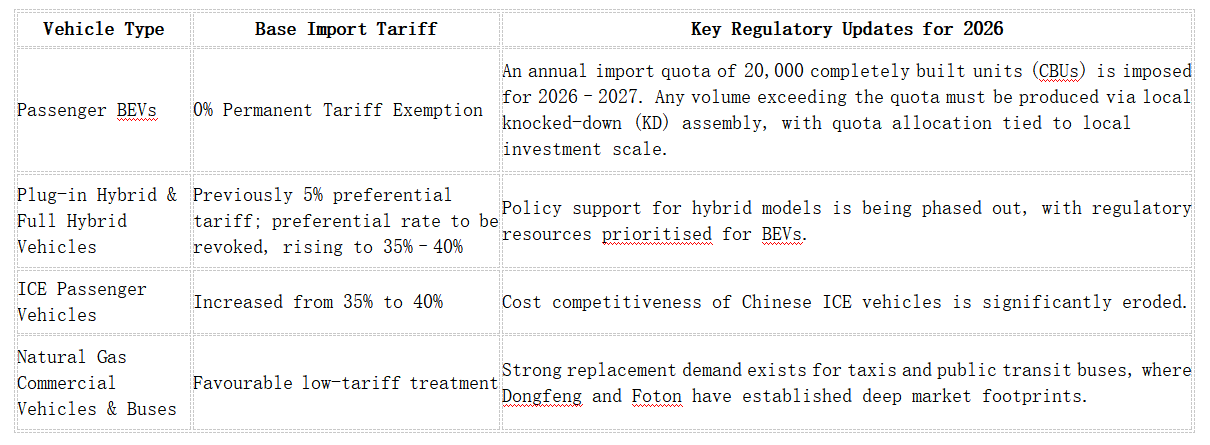
Additional Policy Incentives:
1. Local KD Assembly: Zero tariffs apply to production equipment and moulds. After achieving localised production, manufacturers are exempt from CBU import quotas, and finished vehicles may be exported tariff-free to other Andean Community nations including Ecuador and Peru, making Colombia an ideal hub for Latin American regional production.
2. Electric Taxi Subsidies: A programme targets the electrification of 54,000 taxis with a per-unit subsidy of approximately USD 13,700, generating massive bulk procurement order potential.
3. Charging Infrastructure Mandates: Public charging stations are required to support both Type 2 and CCS2 connectors, and electricity used for vehicle charging is exempt from 20% tax. Rapid infrastructure expansion mitigates range anxiety for BEV users.
3. Core Consumer Preferences in Colombia
1. Model Priority Ranking: Compact SUVs > Family Sedans > Pickup Trucks > Commercial Vehicles & Buses. Mountainous terrain and demand for multi-passenger family transport create strong preference for vehicles with spacious interiors and high ground clearance.
2. Purchasing Decision Drivers: Price sensitivity is extremely high, with cost performance as a primary consideration. Buyers attach critical importance to dealer network coverage and spare parts accessibility for after-sales maintenance. Korean and Japanese brands boast long-standing consumer loyalty, so Chinese brands must compete by building comprehensive service networks.
3. Energy Source Preference Stratification:
o Private household buyers predominantly choose hybrids (75% of NEV sales) to eliminate range anxiety for long-distance travel.
o Ride-hailing fleets, taxis and government fleets prioritise BEVs.
o Freight and logistics operators favour natural gas-powered vehicles.
II. Competitiveness Breakdown of Established Chinese Brands (Sales & Brand Positioning, 2025–2026)
Tier 1: Undisputed NEV Leader – BYD (Benchmark Market Entrant)
Core Performance Metrics
1. Overall passenger vehicle market share reached 4% in Q1 2026, ranking 8th among all brands. BYD holds 45.2% monthly market share and a cumulative 52.7% share in the pure electric segment, controlling over half of Colombia’s BEV market.
2. In the hybrid segment, BYD captured 53.1% market share from January to July 2025, outperforming Kia and Volvo to secure the top hybrid brand position.
3. Product portfolio covers entry-level compact EVs (Dolphin, Yuan PLUS), plug-in hybrid family SUVs (Song PLUS DM-i) and large hybrid SUVs (Tang DM-i), precisely matching mainstream consumer demand.
Strengths & Risks
✅ Advantages:
· Technological moat: Blade Battery and DM-i hybrid technology are highly compatible with Colombia’s mountainous road conditions and mixed short/long-distance usage scenarios.
· Mature channel network with authorised dealerships across Bogotá, Medellín and Cali, Colombia’s three core urban centres.
· Strategic alignment with government policies, securing large-scale orders for official government fleets and electric taxi conversions.
⚠️ Limitations: Restricted by the CBU import quota for BEVs; local KD manufacturing is mandatory to scale production. Chery is rapidly gaining market share and diverting BEV customer traffic.
Tier 2: High-Growth Dual Core – Chery & Changan (Optimal Choices for New Market Entrants)
1. Chery Automobile
· Growth Trajectory: Year-on-year sales growth of 4,141.7% in 2025, with 13.4% share of the BEV segment, making it the fastest-expanding Chinese brand in Colombia.
· Market Strategy: Focuses on cost-effective entry-level BEV SUVs and affordable ICE sedans, undercutting BYD’s pricing to capture mid-tier price-sensitive consumers.
· Market Entry Timeline: Officially launched operations in August 2024 with rapid dealership expansion; the agency model requires minimal upfront sunk costs, making it suitable for lightweight market entry via third-party distributors.
2. Changan Automobile (Deepal Series)
· Strategic Positioning: Colombia is designated as Changan’s electrification pilot hub for Latin America. The brand has fully discontinued ICE vehicle offerings, exclusively launching Deepal pure electric models calibrated for Colombia’s high-temperature climate and rugged road conditions.
· Differentiation Strategy: Targets mid-to-high-end BEV sedans and SUVs to avoid direct low-end price competition with BYD, emphasising intelligent cockpits and extended driving range as key selling points.
· Long-Term Planning: Leverages parent group resources to advance KD factory construction, with the goal of establishing a supply chain base for tariff-free exports to the Andean Community bloc.
Tier 3: Established Commercial Vehicle Base – Foton, JAC & Dongfeng (Must-Consider Segmented Players)
1. Foton
Ranks first among Chinese brands by export volume of passenger and commercial vehicles. Monthly sales hit 523 units in June 2026 with a 2.9% market share, specialising in pickup trucks and light commercial vehicles. Strong demand exists from Colombia’s infrastructure development and rural logistics sectors, and pickup trucks are classified as production equipment with preferential tariff treatment, resulting in far less competition than the passenger vehicle market.
2. Dongfeng
Segment differentiation: Natural gas-powered models account for 40% of its total sales, and the brand holds the second-largest market share in the bus segment. Entering the market in late 2023, Dongfeng operates 18 authorised dealers with plans to expand to 22, focusing on bulk procurement for municipal public buses and corporate shuttle fleets, delivering strong anti-cyclical revenue stability.
3. JAC
Operates dual business lines for light trucks and electric city buses, aligning with national public transport electrification policies. Its passenger vehicle footprint remains limited, so the brand is advised to expand passenger vehicle offerings using its commercial vehicle distribution network as a foundation.
Tier 4: Cautious Trial Players – MG & Great Wall Motors
· MG: Backed by SAIC Motor’s regional distribution system, the brand markets sporty ICE sedans and entry-level BEVs with steady monthly sales of roughly 100 units. Leveraging established South American distributor partnerships minimises market testing risks.
· Great Wall Motors: Pilots two product lines including Haval SUVs and Ora BEVs with monthly sales averaging 60 units. Low brand recognition and delayed localisation investment suggest a wait-and-see approach before large-scale market investment.
III. Three Market Entry Strategies for New Brands (Ranked by Capital Input & Risk Exposure)
Strategy 1: Lightweight Authorised Distribution Model (Recommended for Startups & Niche Automakers)
Target Brands: Leapmotor, Neta, GAC Aion, FAW Besturn and other marques not yet present in Colombia
1. Implementation Framework: Sign exclusive distribution agreements with Colombia’s top five automotive retail groups, which control 70% of national sales channels. The OEM only supplies finished vehicles without direct offline store operation.
2. Core Benefits: Zero direct offline operational expenditure; local distributors manage quota applications, customs clearance and after-sales service in compliance with national regulations.
3. Product Selection Principle: Only apply for zero-tariff BEV import approvals, prioritising compact city EVs directly competing with BYD Dolphin while avoiding head-on rivalry with BYD’s core SUV product line.
4. Drawbacks: Limited channel bargaining power, profit margins diluted by distributor commissions, and challenges in long-term brand equity building.
Strategy 2: Semi-Localised KD Knock-Down Assembly (Optimal Long-Term Approach, Adopted by BYD & Chery)
Target Brands: Mainstream OEMs with overseas manufacturing roadmaps aiming to build a regional export base for the Andean region
1. Policy Advantages: Qualify for industrial project incentives for electric vehicle manufacturing with zero tariffs on production equipment, eliminating dependency on the annual 20,000 CBU import quota. Total landed costs are reduced by 15%–25% via lower tariffs on disassembled KD parts versus fully built vehicles.
2. Cross-Border Market Expansion: Vehicles manufactured under Andean Community rules qualify for tariff-free exports to Peru, Ecuador and Bolivia, establishing a western South American supply chain centre with a single production facility.
3. Recommended Factory Locations: Free Trade Zones in Bogotá and industrial bonded zones in Medellín, offering tax exemptions and streamlined logistics access.
Strategy 3: Capital-Intensive Full Vehicle Manufacturing (Only Viable for Top-Tier Large OEMs)
Restricted to major manufacturers such as BYD and Geely, which qualify for targeted government industrial subsidies and can secure large national tenders for taxi and public bus fleets. The primary disadvantage is upfront fixed asset investment exceeding USD tens of millions, alongside elevated risks from potential shifts in national industrial policy.
IV. Targeted Brand Selection by Market Segment
1. Pure Electric Passenger Vehicle Segment (Most Intensely Competitive)
✅ Top Pick: BYD – Dominant market leadership with stable order pipelines and unmatched policy, channel and product barriers. ✅ Secondary Pick: Chery – Fastest sales growth, straightforward distributor onboarding and tiered pricing to avoid saturated market segments. ✅ New Entrant Options: GAC Aion and Changan Deepal, pursuing differentiated positioning via long driving range and intelligent vehicle features to avoid direct competition.
2. Hybrid Vehicle Segment (Diminishing Policy Benefits; Cautious Market Entry Advised)
Planned revocation of the 5% preferential tariff will align hybrid vehicle import costs with ICE vehicles by 2027. Only BYD’s DM-i hybrid line retains established user loyalty; other brands are discouraged from launching new hybrid product lines in this market.
3. ICE Passenger Vehicle Segment (Not Recommended for New Brands to Invest Heavily)
A 40% import tariff on ICE vehicles eliminates the historic price advantage of Chinese ICE models. Kia, Renault and other legacy brands have decades of entrenched dealer networks and spare parts ecosystems. Only limited small-scale trial imports of legacy Great Wall Haval and Changan ICE models are feasible.
4. Commercial & Specialised Vehicle Segment (Blue Ocean High-Demand Niche)
· Pickups & Light Trucks: Foton > JAC. Essential for Colombia’s agriculture and logistics sectors; pickups are classified as capital goods with favourable tariff structures and far less competitive pressure than passenger cars.
· Public Transit Buses: Dongfeng, offering both natural gas and electric powertrains to align with municipal bus fleet electrification and gas conversion policies.
· Bulk Electric Taxi Procurement: Prioritise BYD and Chery to directly access government subsidy programmes.
5. Premium New Energy Vehicle Segment
Zeekr and NIO may introduce limited product batches. High-income consumer clusters are concentrated in Bogotá and Medellín, while Tesla maintains minimal local market presence. This segment features almost no established local luxury EV competitors, making it suitable for small-volume brand image building.
V. Core Market Entry Risks & Mitigation Strategies
1. Regulatory Risk Surrounding Import Quotas
A hard cap of 20,000 annual CBU BEV imports is enforced for 2026–2027, with quota allocation proportional to local capital investment. �� Mitigation: Reduce reliance on finished vehicle imports by securing KD assembly certification in advance to bypass quota restrictions entirely.
2. After-Sales Service & Channel Deficit Risk
Korean and Japanese competitors operate service networks extending to secondary and tertiary cities, while most Chinese brands only maintain coverage in major metropolitan areas, creating maintenance barriers for remote customers. �� Mitigation: Form joint service stations with established local dealer groups and bundle three-year standard maintenance packages with vehicle sales.
3. Exchange Rate Volatility & Geopolitical Policy Instability
The Colombian Peso suffers significant exchange rate fluctuations, and left-wing administrations frequently revise industrial regulations including hybrid tariffs and assembly compliance rules. �� Mitigation: Structure sales contracts in US Dollars with price adjustment clauses tied to currency fluctuations; prioritise facility establishment within Free Trade Zones to lock in stable tax and tariff terms.
4. Competitive Pressure from Established OEMs
Kia and Renault are accelerating their electrification roadmaps, leveraging their existing nationwide dealer networks to launch low-cost electric models rapidly. �� Mitigation: Establish clear brand differentiation via extended warranty packages. Local competitors typically offer 3-year vehicle warranties, while Chinese brands may offer 6–8 year coverage for batteries and whole vehicles to shape unique customer value perception.
VI. Final Brand Priority Ranking for Market Entry
1. Best Established Option: BYD – Unrivalled leading position in the NEV market with comprehensive advantages in policy alignment, sales channels and product competitiveness.
2. Low-Risk First-Time Entry Option: Chery – Industry-leading sales growth, simple distributor partnership setup and tiered pricing to avoid oversaturated market competition.
3. Long-Term Regional Strategic Choice: Changan Deepal – Corporate-level designation of Colombia as a Latin American electrification hub with a pure EV-only product strategy aligned with national long-term industrial policy.
4. Segment-Specific Commercial Vehicle Pick: Foton & Dongfeng – Bypass crowded passenger vehicle competition and anchor revenue via infrastructure and government bulk procurement tenders.
5. Watchlist & Pilot Entry Only: Great Wall Motors & MG – Insufficient differentiated channel and product positioning; recommended to launch small-scale distributor pilot programmes before large-scale market expansion.
Upon request, I can produce a customised market entry feasibility report and head-to-head competitor benchmarking document for any specific marque (such as Geely, Neta or GAC).